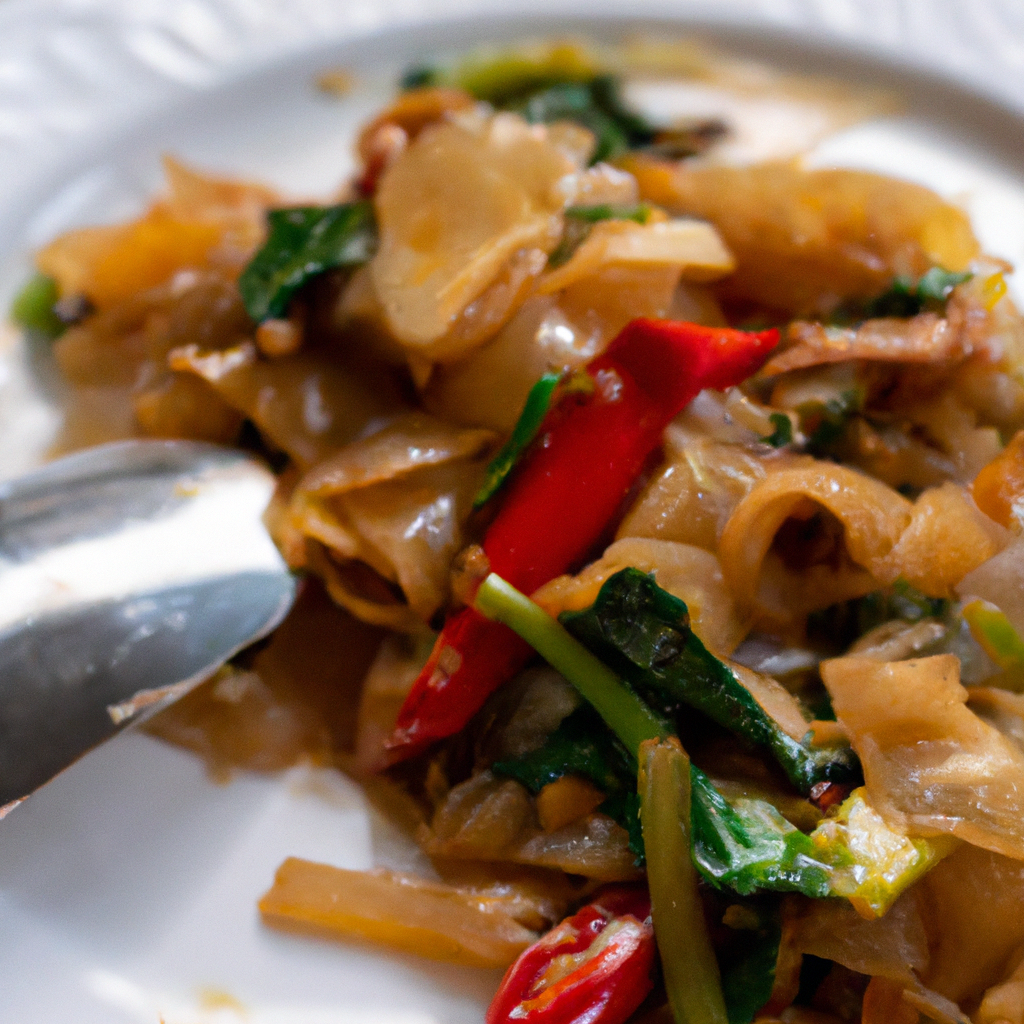
What is Pad See Ew?
In English the name means "stir-fried with soy sauce": phat means to stir-fry, and si-io is the Thai word for soy sauce. The dish comes from Thailand's Chinese-influenced street kitchens and is related to Cantonese chow fun. In Bangkok you find it at many noodle stalls. Compared with Pad Thai, it has no tamarind, peanuts or bean sprouts. The soy sauce carries all the seasoning, so Pad See Ew tastes rounder and less sour.
Sen Lek or Sen Yai: which noodles?
Sen lek are narrow rice noodles, about 3 to 5 mm wide, the same ones you use for Pad Thai. At street stalls Pad See Ew usually comes with sen yai, fresh wide rice noodles 2 to 3 cm across. Both versions are right. This recipe uses the narrow noodles because you can buy them dried at an Asian grocery store. Fresh sen yai are in the refrigerated section of larger Asian supermarkets. Separate the sheets before stir-frying, or they clump in the wok. For types and soaking times, see rice noodles.
The right ingredients
- Dark soy sauce: It colors the noodles brown and adds a hint of molasses. Thai dark soy sauce (si-io dam) is thicker and sweeter than the Chinese kind. The light soy sauce supplies the salt. The article on light and dark soy sauce explains the difference.
- Chinese broccoli: At an Asian grocery store it is sold as kai lan or gai lan, and in Thailand as kana. Slice the stems thinly on the diagonal and chop the leaves roughly. Broccolini or bok choy work as substitutes.
- Meat: Chicken breast cooks in 3 minutes, while thigh stays juicier. At Thai stalls you find Pad See Ew just as often with pork.
- Oyster sauce: An extra tablespoon of oyster sauce makes the sauce rounder and glossier. Many noodle stalls add it.
How to get Pad See Ew right
Soak the noodles instead of boiling them
Put dried sen lek in lukewarm water until they are pliable but still have a firm core. Depending on the brand, that takes 20 to 30 minutes. The noodles finish cooking in the wok with the sauce. Fully boiled noodles fall apart when you toss them.
High heat, small batches
For charred flavor the noodles need contact with hot metal. So cook no more than two portions at a time. Add the soy sauces at the edge of the wok, leave the noodles alone for 30 to 60 seconds, and only then toss them. A large nonstick pan works too, but the charred flavor is weaker there.
The egg in the gap
Push the meat and garlic to the side, crack the eggs into the empty spot and let them set for 20 seconds before you break them up and fold them in. That keeps pieces of egg visible in the dish instead of coating the noodles in a film.
Common mistakes
- Noodles too soft: They tear and stick together. Drain them as soon as they bend easily.
- All the sauce in the middle: The noodles simmer in liquid instead of frying. At the hot edge, the sauce caramelizes.
- Raw broccoli: Thick stems need 1 to 2 minutes longer than the leaves. Add the stems to the wok first, then the leaves.
Variations and calories
For a vegetarian version, fry cubed firm tofu until crisp beforehand and use a vegetarian mushroom sauce instead of oyster sauce. Thinly sliced beef gives a stronger flavor. One serving of this recipe has about 550 kcal, mostly from the noodles and oil. Using 1 tbsp of oil instead of 2 saves about 60 kcal per person.
What to serve with it
At Thai noodle stalls the table holds chili vinegar, chili flakes, sugar and fish sauce, and you season to taste yourself. A few chili slices in rice vinegar do the job at home. As a second dish, try Pad Krapow or a Kai Dao, the crispy Thai fried egg, which you can also lay right on top of the noodles.