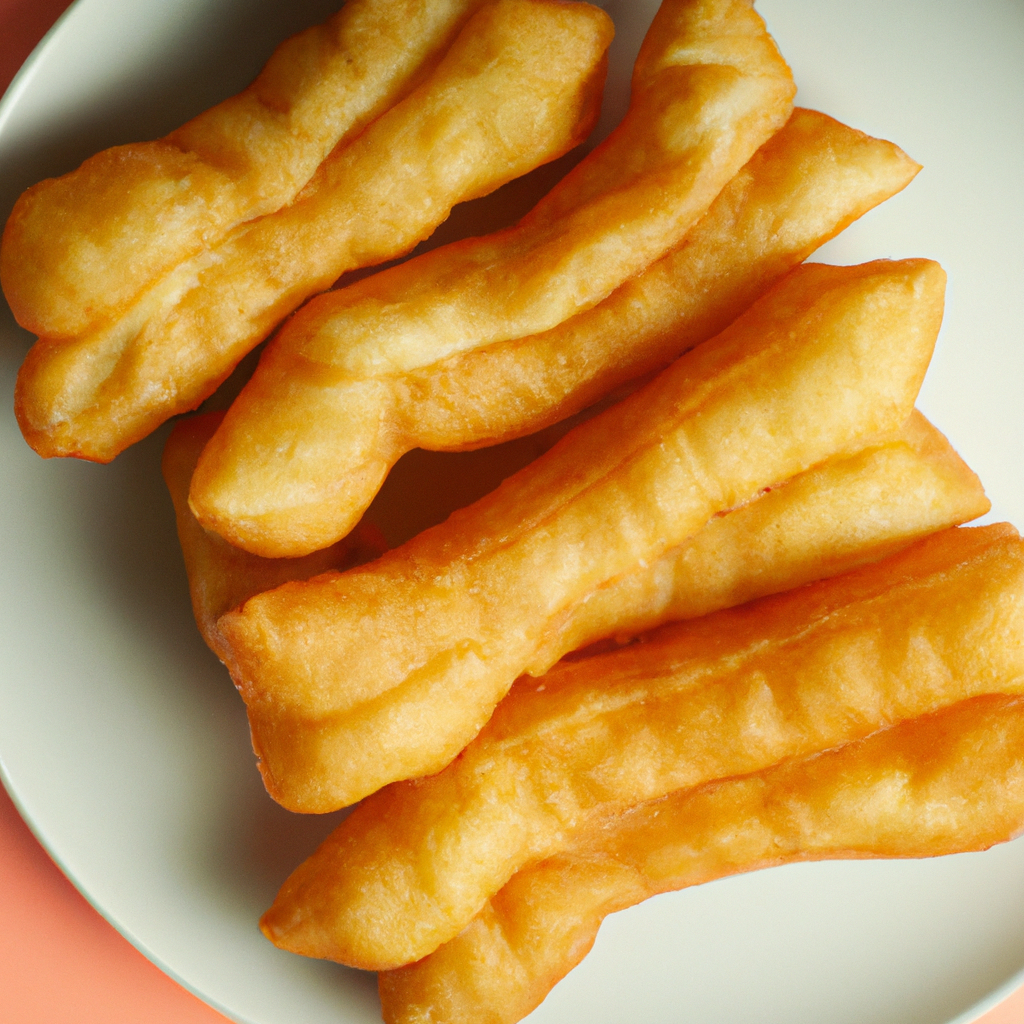
What are Yóu Tiáo?
Yóu means oil, tiáo means stick. Street stalls in China and Taiwan fry them fresh in the morning and sell them next to soy milk and filled buns. In Hong Kong and Guangdong they are called yau za gwai. In English you find them as Chinese cruller or Chinese doughnut. Fried dough sticks describes them best. The American cruller is a twisted or piped fried pastry made from a different dough.
The dough: leavening and resting time
Street kitchens work with baking soda, alum, or baker's ammonia, which puff the dough in the hot oil. At home you use yeast and baking powder, as on the recipe card. The dough should be soft and slightly sticky. Knead it for 5 minutes, rub it with a little oil, and let it rise covered. One hour is the minimum. If it then rests overnight in an oiled container in the refrigerator, the gluten relaxes, and you can stretch the strips to double their length without tearing. Take the dough out an hour before frying.
Shaping: two strips and a chopstick
Roll the dough out on a floured surface into a rectangle about 1 cm thick and 10 cm wide. Cut strips 2 cm wide, lay two on top of each other, and press a chopstick lengthwise into the middle. When frying, both halves puff up and stay joined at the pressed line. That gives you the typical double stick with a hollow inside. Over the pot, stretch each pair by the ends to about 20 cm long and put it straight into the oil.
Frying
Heat the oil to 190 °C (375 °F). Without a thermometer, test with a small piece of dough: it rises within two seconds and throws off bubbles. Put two or three sticks into the oil and keep rolling them back and forth with chopsticks. After a few seconds they puff up, and after about 2 minutes they are golden brown. Canola or peanut oil holds the temperature without smoking.
Common mistakes
- Oil too cold: Below 180 °C (355 °F) the sticks soak up oil and stay flat.
- Dough too stiff: With too little water it tears when stretched and barely rises. Add water a tablespoon at a time until it sticks to your fingers.
- Single strips: A single strip puffs in the oil but stays dense and bready inside.
- Stored too long: After a few hours Yóu Tiáo turn chewy. Crisp them up for 5 minutes at 180 °C (355 °F) in the oven.
How to eat Yóu Tiáo
For breakfast, dunk the sticks in warm soy milk (Dou Jiang). In Taiwan there is savory soy milk with vinegar, dried shrimp, and pieces of Yóu Tiáo as a topping. You can find a recipe along those lines under soy milk soup. For rice porridge such as shrimp congee, cut them into pieces and sprinkle them over the top. In Shanghai, a piece of Yóu Tiáo is rolled into steamed sticky rice (Ci Fan Tuan). Prepare the rice for it following the instructions in Cooking sticky rice. For a Taiwanese breakfast, Dan Bing also goes well.